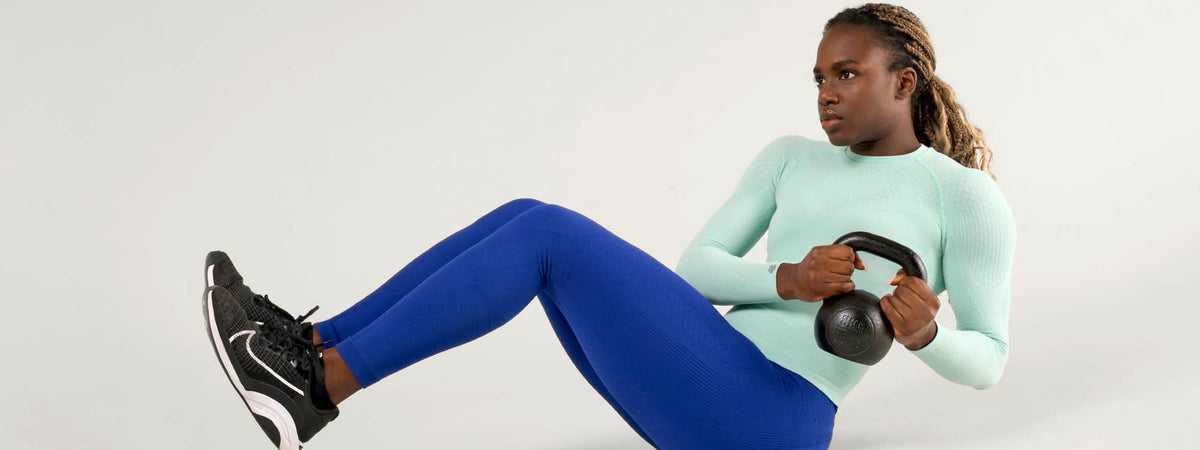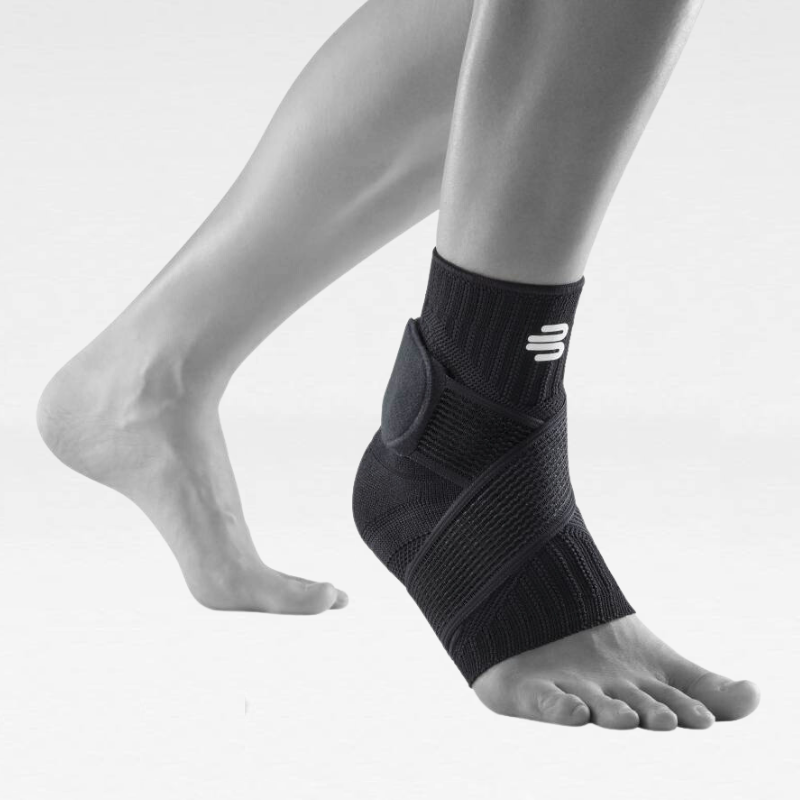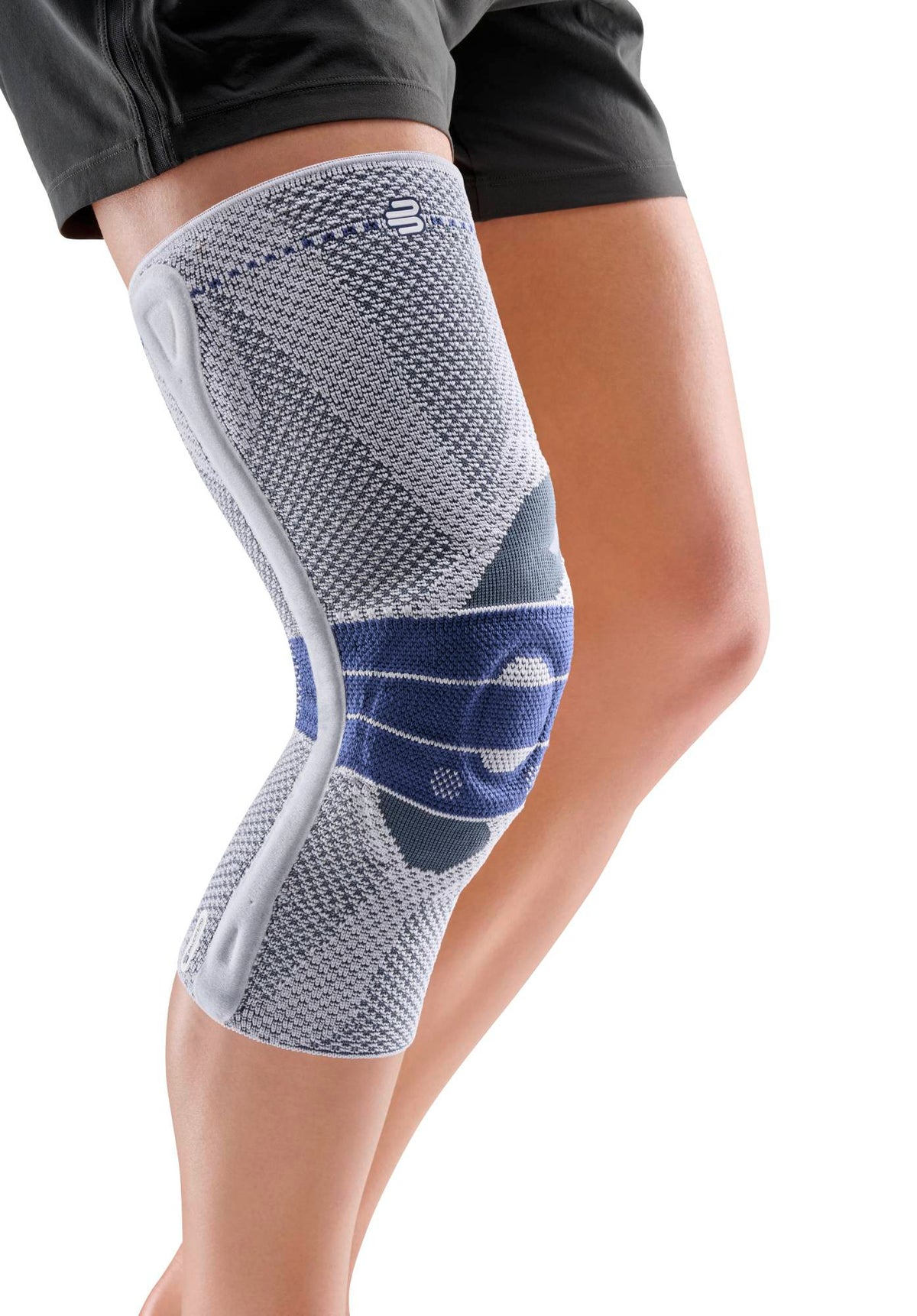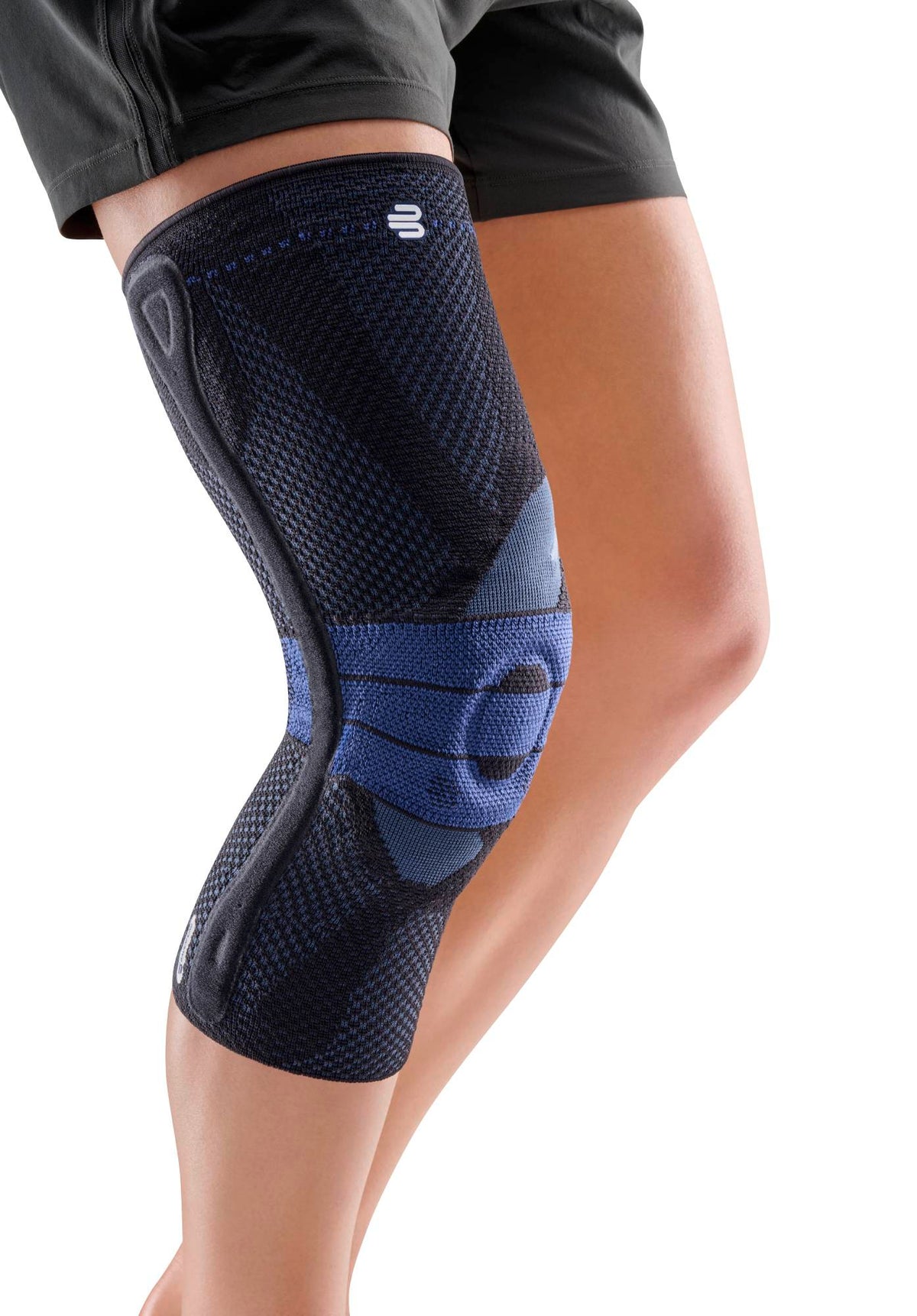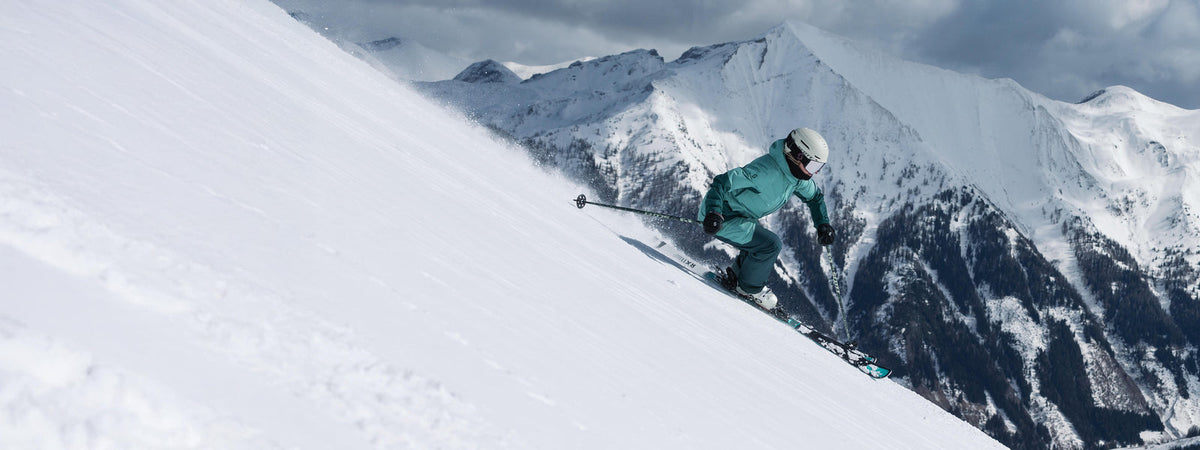
If you have had an ACL, MCL or other knee ligament injury, the right knee brace for skiing depends on how stable your knee is now and what your surgeon or physiotherapist advises. A knitted sleeve suits a healed, well-rehabilitated knee; a hinged knee brace with straps adds mechanical support; a rigid frame is for clinician-prescribed protection.
At a glance
- In a 2012 laboratory study of 28 adults with an unrepaired ACL rupture, the Bauerfeind SofTec Genu hinged soft brace reduced forward shin laxity by 33% (8.3 mm to 5.6 mm), against 14% for a rigid shell brace.
- In the same study, participants swayed 20% less after a sudden sideways nudge and built up force 17% faster in a jump test wearing the SofTec Genu.
- In a 2020 Karlsruhe study of 17 adults with an unstable ACL-deficient knee, a hinged soft brace and a rigid brace both lowered the knee's peak inward (valgus) angle when the foot was tipped sideways; all changes were 1 to 3 degrees.
- In a University of Otago trial of 34 adults after ACL reconstruction, a GenuTrain knitted sleeve increased single-leg hop distance by 3.6% (about 5 cm) on the day, but six weeks of wear gave no extra benefit over no sleeve.
- None of these studies tested skiing: every result comes from walking, balance, turning or hopping tasks in a laboratory.
Why a knee brace for skiing is on your mind now
The Alpine season opens in early December, and if you have a ligament history the nerves tend to arrive with the booking confirmation. The authors of the 2020 Karlsruhe study note that skiing is among the sports with the highest rates of anterior cruciate ligament (ACL) injury.
For skiers without a ligament history, start with our guide to knee support for skiing. One thread runs through everything here: the decision belongs with you and your physiotherapist or surgeon, who know how your ligament was treated.
What a hinged knee brace does that a sleeve does not
Knitted sleeve
A knitted sleeve such as the Bauerfeind GenuTrain knee support is elastic fabric with a pad around the kneecap and flexible stays. It does not hold the joint in place mechanically. Research groups describe its stiffness as low and attribute any effect to proprioception, which is your sense of where the joint is in space, and to confidence.
Hinged knee brace with straps
A hinged knee brace keeps the knitted fabric but adds rigid side splints joined by a hinge, plus straps above and below the joint. The splints resist the two loads that matter after a ligament injury: the shin sliding forward on the thigh bone, and the knee twisting or collapsing inwards. The Bauerfeind SofTec Genu, GenuTrain S and GenuTrain S Pro sit here.
Rigid frame brace
A rigid frame brace such as the Bauerfeind SecuTec Genu Flex replaces the fabric with a frame and non-elastic straps. The hinges can limit bending and straightening, or lock the knee. Clinicians prescribe this category for the protected phase of rehabilitation, when a healing or reconstructed ligament must be shielded.
What the research says about sleeves and hinged braces
Strutzenberger and colleagues, 2012: laxity, balance and jumping
In a 2012 laboratory study, 28 adults (average age 40) with an unrepaired ACL rupture and repeated giving-way episodes were tested with no brace, in a SofTec Genu and in a rigid shell brace. Laxity is how far the shin can be pulled forward on the thigh bone, measured with a KT-1000 arthrometer.
Wearing the SofTec Genu, forward shin laxity fell by 33%, from 8.3 mm to 5.6 mm, compared with a 14% reduction to 7.1 mm in the rigid brace. After a sudden sideways nudge, participants swayed 20% less with the SofTec Genu on, and in a counter-movement jump their leg built up force 17% faster than without a brace. Simple tasks such as standing balance, short jump landings, strength and joint-position sense showed no brace effect.
The authors concluded that braces might not be needed for simple daily tasks but could provide beneficial support in more exposed situations or when returning to sport after an ACL injury. The tests were single-session, at loads well below those of sport, and no pain, function or injury outcomes were measured.
Focke and colleagues, 2020: a tilting plate and a sharp turn
In a second Karlsruhe study, 17 adults (average age 44) with an unrepaired ACL rupture and an unstable knee walked over a plate that tipped the foot sideways, then performed a 180-degree turn, in a SofTec Genu, a rigid brace and no brace. Valgus is the knee collapsing inwards towards the other leg.
Both braces lowered the peak valgus angle during the perturbed walk by a similar amount, and both reduced outward shin rotation at foot contact in the turn. The soft brace changed the walking pattern less than the rigid brace, while the rigid brace limited outward shin rotation more during walking. Both slightly increased inward shin rotation, which the authors flag for future study. In the turn, no brace outmatched the other. All changes were 1 to 3 degrees, which the authors say might not be clinically relevant.
The Otago trial, 2021 to 2022: a knitted sleeve after ACL reconstruction
The University of Otago in New Zealand, led by Sole and colleagues, tested the GenuTrain sleeve in 34 adults aged 18 to 40 who still had some functional limitation six months to five years after ACL reconstruction, reporting it in three papers.
On the day, hopping on the operated leg with the sleeve went 3.6% further (about 5 cm), although the authors note this is below the test's 8% minimal detectable difference. In 31 participants, landing from a step-down hop with the sleeve brought about 3 degrees more knee bend, closer to the uninjured leg's pattern. No participant reported an adverse effect.
Over six weeks of wearing the sleeve for at least an hour a day, the sleeve group did not improve self-reported knee function, hop distance or thigh strength any more than the no-sleeve group. The authors state that their data do not support routine use of knee sleeves after ACL reconstruction, and that a sleeve should be prescribed individually as an adjunct to rehabilitation, with training done without it as well. More in our post on knee support after ACL reconstruction.
A note on rigid frames
In a laboratory bench test on an anatomical leg model at FH Münster University of Applied Sciences, Bauerfeind reports that the partly flexible SecuTec Genu Flex resisted forward-backward shin movement and inward-outward twisting to a similar degree as its conventional rigid-frame orthosis, though the test used no patients and shows mechanical stiffness only, not any outcome for a wearer.
To be clear: no study described here tested skiing, and none measured re-injury rates.
How to choose a ski knee brace after a ligament injury
- Ask your physiotherapist or surgeon first. If your ligament was reconstructed or is still healing, they may want you in a specific category, or not skiing yet.
- Match the brace to the knee you have now. A knee with measurable laxity or giving-way episodes is the population the SofTec Genu studies tested. A stable knee cleared for sport is closer to the Otago sleeve population.
- Wear it in before the trip. The 2020 study had participants wear each brace for at least four weeks before testing. Walk, squat and step down in it at home first.
- Test it with your ski trousers and boots. Check that the straps clear the boot cuff and nothing slides when you flex.
- Keep training without it. The Otago authors advise that sleeve users also train without one, and every study positioned bracing as an adjunct to rehabilitation. Our six-week knee preparation plan is the other half.
Which knee support for skiing is right for you?
Only the SofTec Genu and the GenuTrain were tested in the studies above, so the research tells you about the category, not the specific product. Your clinician's advice comes first.
- Bauerfeind GenuTrain knee support: the knitted sleeve, for a rehabilitated, stable knee where you want awareness rather than mechanical control.
- Bauerfeind GenuTrain S knee support: knitted support with lateral joint splints and adjustable straps, designed for slight instability.
- Bauerfeind GenuTrain S Pro knee support: lateral splints with adjustable hinges and two inelastic straps, so bending and straightening can be restricted.
- Bauerfeind SofTec Genu: the hinged soft brace tested in both Karlsruhe studies, with rigid aluminium sidebars, range-of-motion control and lock-out.
- Bauerfeind SecuTec Genu Flex: the rigid frame option, with a 4-point stabilisation system, adjustable flexion and extension limits or full immobilisation, for clinician-prescribed protection.
Browse the full ligament supports for the knee range, or the skiing and snowboarding supports collection.
Quick answers
Do I need a hinged knee brace for skiing after an ACL reconstruction?
Not automatically. It depends on how stable your knee is now and what your surgeon advises. The hinged-brace research was done in people with unrepaired ACL ruptures and persistent instability, not reconstructed knees. If your reconstruction has healed and you are cleared for sport, your physiotherapist may suggest a sleeve, a hinged brace or nothing at all.
Is a knitted sleeve enough after a ligament injury?
For a healed, stable, rehabilitated knee it may be all you want. In the Otago trial a GenuTrain sleeve produced small same-day changes in hop distance and landing pattern, but six weeks of wear gave no extra benefit, and the authors do not support routine use. A sleeve does not mechanically restrain the joint, so it is not a substitute for a prescribed hinged brace.
Can a ski knee brace prevent a ligament injury?
No study here measured injury or re-injury rates, so nobody can promise that. The research shows that a hinged brace reduces forward shin laxity and limits inward collapse in controlled tasks, and that a sleeve may improve knee awareness. Skiing itself was not tested. Treat a brace as one part of a plan that includes strength work and your clinician's clearance.
When should I talk to a physio or surgeon rather than buy a brace?
Before you book, if you can. Speak to a clinician if your knee gives way, swells after activity, locks, or has not been formally cleared for sport since the injury. They can test laxity and strength, tell you which category fits, and advise on whether to ski this season. A brace is never a reason to skip that conversation.
This article is for general information only and is not medical advice. If you have persistent pain, swelling, locking, giving way or an injury, speak to a GP or physiotherapist before using a support. Reviewed by the Joint Operations product team.
Sources
- Strutzenberger G, Braig M, Sell S, Boes K, Schwameder H, 2012. Effect of Brace Design on Patients with ACL-Ruptures. International Journal of Sports Medicine 33: 934-939. DOI 10.1055/s-0032-1304634.
- Focke A, Steingrebe H, Möhler F, Ringhof S, Sell S, Potthast W, Stein T, 2020. Effect of Different Knee Braces in ACL-Deficient Patients. Frontiers in Bioengineering and Biotechnology 8: 964. DOI 10.3389/fbioe.2020.00964.
- Sole G and colleagues, 2021. Knee sleeve after ACL reconstruction: hop distance, self-reported function and thigh strength (n=34). BMC Musculoskeletal Disorders 22: 655.
- Sole G and colleagues, 2022. Knee kinematics and kinetics during a step-down hop with a knee sleeve after ACL reconstruction (n=31). BMC Musculoskeletal Disorders 23: 560.
- Sole G, Pataky T, Hammer N, Lamb P, 2022. Ground reaction forces and knee joint power with a knee sleeve after ACL reconstruction (n=30). PLoS ONE 17(12): e0272677.
- Bauerfeind AG, 2025. SecuTec Genu Flex: Assessment of the stabilizing effect of a knee orthosis. Manufacturer information sheet summarising a bench test at FH Münster University of Applied Sciences, Germany.