Updated October 2026.
A knee support for skiing is a knitted compression sleeve worn under your salopettes to improve the feeling of stability and control on the slopes. Most recreational skiers without a ligament injury do well with a sleeve such as the Bauerfeind Sports Knee Support. After a ligament injury, a hinged brace is often the better choice.
At a glance
- In a 2015 University of Freiburg study of 18 adults with knee osteoarthritis, participants reported a median 2.5 point increase in perceived stability on a 10 point scale while wearing a GenuTrain knee support.
- In a 1993 University of Tubingen study of 59 people with knee osteoarthritis, joint-position-sense error fell from 13.1 to 11.2 degrees (passive test) and from 14.2 to 12.5 degrees (active test) with the support on. It made no difference in healthy knees.
- In a 2012 lab study of 28 adults with an unrepaired ACL rupture, the hinged SofTec Genu reduced forward shin laxity from 8.3 mm to 5.6 mm, compared with 7.1 mm in a rigid brace.
- No study in our evidence base tested a knee support while skiing. All findings come from walking, balance and jump tests in a laboratory.
Reduce the strain on your knees while skiing
Skiing accidents happen quickly. The knee is one of the most commonly injured joints in skiing, and many people who have had a knee injury still notice their knee during a ski week, even after rehabilitation and strength training. Even without a previous injury, it is common to feel the knees ache after a few days on the piste.
Whether or not the ache is linked to an old injury, wearing a knee support for skiing is designed to:
- improve your sense of stability and control in the knee,
- help you feel where the joint is during a turn or landing,
- support the knee against excessive strain, and
- help relieve knee pain from overload during and after a ski day.
The important thing with knee pain when skiing is to avoid excessive strain. Skiing loads the muscles and ligaments heavily, and the knee joint most of all. Sideways loads and rotation push on the menisci (the two crescent-shaped cartilage cushions inside the knee) and pull on the ligaments. Those pressure and tensile loads can cause pain and, in a fall, injury. The vibration from hard, uneven snow adds further strain on the muscles and joints.
Good preparation for the season is essential. If the thigh and hip muscles are not strong enough, the knee can drift inwards under load, which is a common source of knee pain in skiers. Well-trained muscles give you better control of the knee. A knee support offers additional help on the day, but it does not replace the training. Our six-week plan to prepare your knees for skiing sets out the exercises.
Good reasons for a Bauerfeind Sports knee support
Bauerfeind Sports knee products are developed with athletes and are designed for people who want to push themselves on the mountain.
Pain relief and joint awareness. The knit and the kneecap pad are designed to give targeted joint guidance and noticeable relief from overload pain, together with improved joint awareness (proprioception, the body's sense of where a joint is in space) that helps your muscles react in time.
A secure fit during dynamic movement. The anatomical fit of the Sports Knee Support is designed to keep it in place through every turn, so you can concentrate on the run rather than on the support.
Lightweight and heat-regulating. The 3D AirKnit fabric lets your skin breathe. Moisture evaporates quickly so the support stays comfortable under a base layer.
What the research says about knee supports
No study in our evidence base tested a knee support while skiing, so the findings below come from walking, balance and jump tests in a laboratory. In a 2015 University of Freiburg study published in PLoS ONE, Schween, Gehring and Gollhofer measured 18 adults aged 25 to 65 with knee osteoarthritis walking with and without a Bauerfeind GenuTrain knee support. Participants reported a median 2.5 point increase in perceived stability on a 10 point scale while wearing it, and a slight easing of pain (median 0.5 points). The researchers attributed the effect to improved joint awareness rather than mechanical bracing, and measured only same-day effects.
That fits the earlier work from the University of Tubingen. In a 1993 study of 59 people with confirmed knee osteoarthritis, Sell, Zacher and Lack found that joint-position-sense error, the gap between where the knee actually is and where the person feels it is, fell from 13.1 to 11.2 degrees in a passive test and from 14.2 to 12.5 degrees in an active test when a GenuTrain support was worn. The same support made no measurable difference in people with healthy knees, which the authors read as compensation for a sensory deficit rather than mechanical stabilisation. Regular physiotherapy was also linked to better joint-position sense, so a support is a complement to exercise, not a replacement for it.
For hinged supports after a ligament injury, the closest evidence is a 2012 study at the Karlsruhe Institute of Technology. Strutzenberger and colleagues tested 28 adults (average age 40) living with an unrepaired ACL rupture. Wearing the hinged SofTec Genu reduced forward slippage of the shin on a standard laxity test from 8.3 mm to 5.6 mm, compared with 7.1 mm in a rigid hinged brace, and participants swayed about 20 per cent less after a sudden sideways nudge. These were single-session tests at loads well below skiing, and the brace was not shown to prevent re-injury.
The knee support for skiing: how the Bauerfeind Sports Knee Support can help
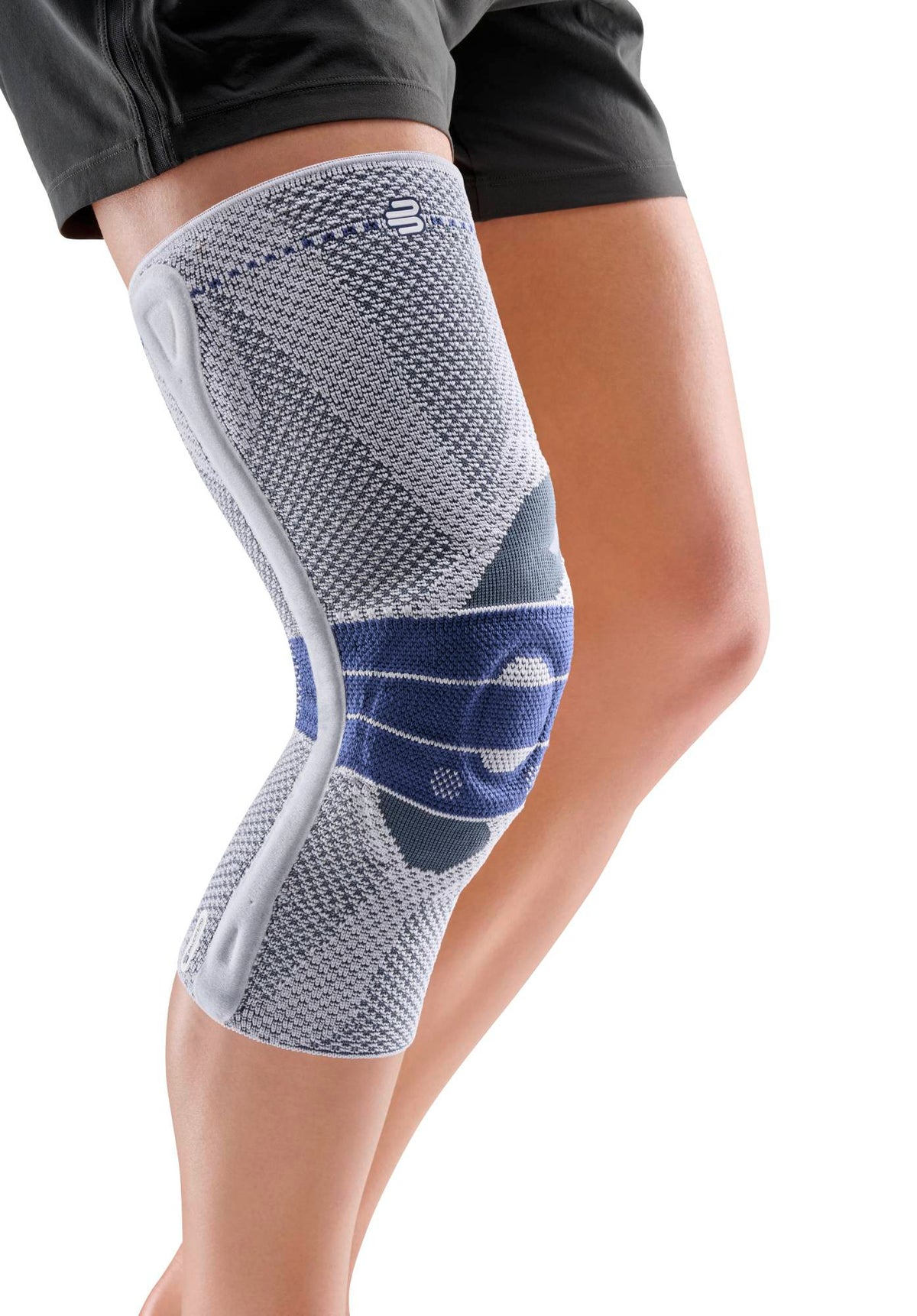
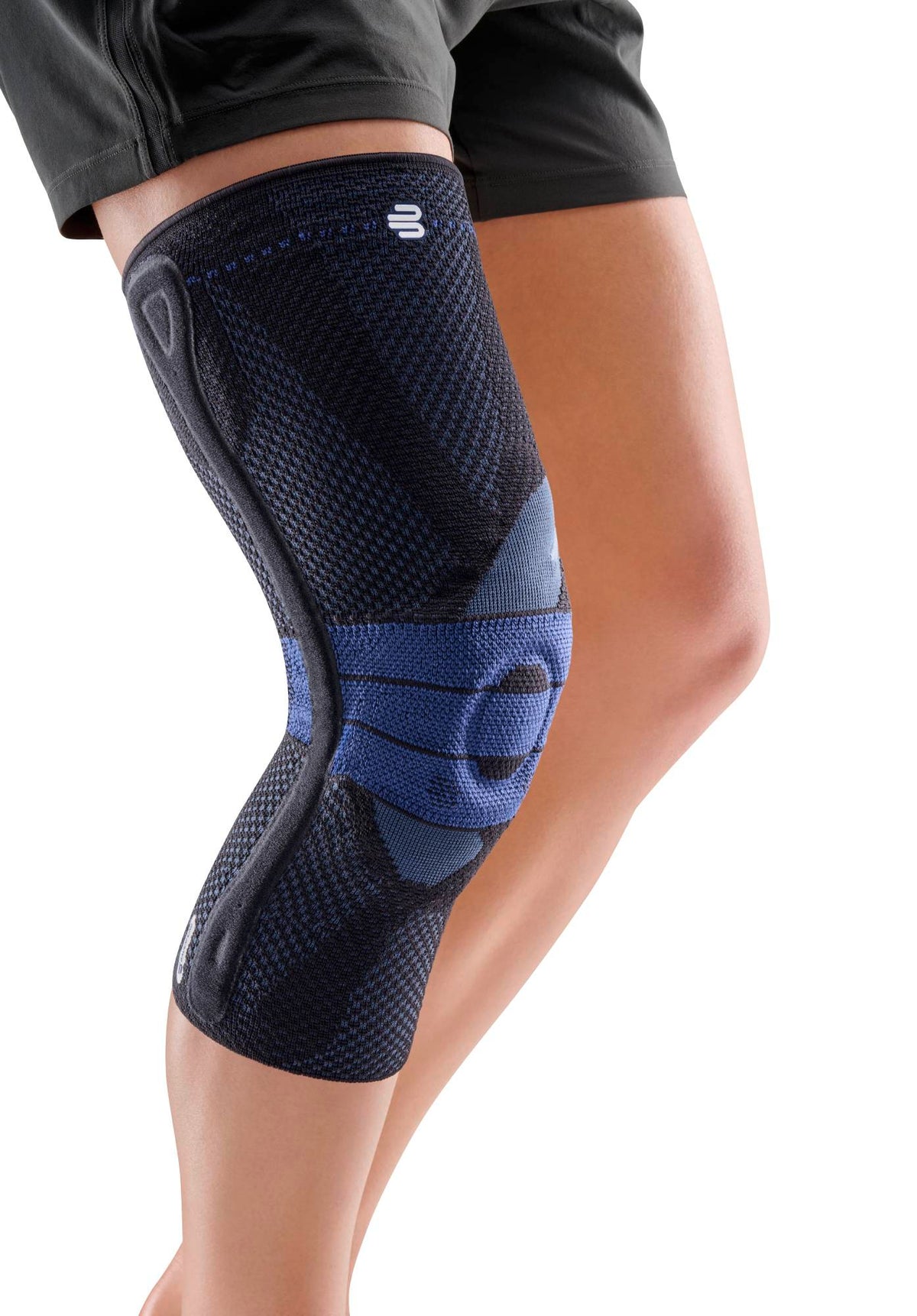
The Bauerfeind Sports Knee Support is designed to help with knee pain and excessive strain during skiing. The compression knit is designed to support the knee, improve joint guidance and help reduce swelling after a hard day. With a better sense of stability in the knee, many skiers find they have more control. The firmness of the knit, combined with full freedom of movement, means the knee is supported through its natural range.

The importance of the pad: skiing after a cruciate ligament injury
Skiing after meniscus surgery, after cruciate ligament reconstruction, or without a cruciate ligament at all? Many people do return to skiing in the season after knee surgery, but the timing is a decision for your surgeon or physiotherapist. Once an injury has healed, or where the joint is worn, compression alone is often not enough. That is why the Sports Knee Support combines compression with a ring-shaped pad that is designed to guide the kneecap and spread pressure away from it.
If your knee gives way, or you have had an ACL or MCL injury, read our guide to choosing a hinged knee brace for skiing before you decide. A sleeve and a hinged brace do different jobs.
Stabilise your knees through the whole day
The gentle compression is designed to improve your control of the knee during long descents and full days on the slopes. During movement, the Sports Knee Support works on the ligaments, muscles, tendons and connective tissue with a light massaging effect that is thought to support sensorimotor function (the loop between what the joint senses and how the muscles respond). Many skiers find that wearing it regularly helps them feel steadier late in the day, when tired legs make the knee harder to control.
Which knee support for skiing is right for you?
Start from your situation, not from the product. Pain and tired knees with no history of ligament injury point to a sleeve. Giving way or a past ligament injury points to a hinged brace, chosen with your physiotherapist.
- Bauerfeind Sports Knee Support: the all-round choice for recreational skiers with achy or tired knees and no ligament injury. Light, breathable, with the Omega kneecap pad.
- Bauerfeind GenuTrain knee support: the medical-grade sleeve from the Freiburg and Tubingen studies. Suits skiers managing osteoarthritis or long-standing knee pain.
- Bauerfeind GenuTrain P3 knee support: for kneecap (patellofemoral) pain or a kneecap that tracks outwards, with corrective straps and a shaped pad.
- Bauerfeind GenuTrain S knee support and GenuTrain S Pro: hinged sleeves with side splints for skiers who need sideways stability after a ligament injury.
- Bauerfeind SofTec Genu: the knitted hinged brace from the 2012 laxity study, for an unstable knee after an ACL injury, fitted on specialist advice.
Browse the full skiing and snowboarding supports range, and if you ride rather than ski, see our post on preventing knee pain after snowboarding.
Quick answers
Should I wear a knee support for skiing?
Yes, if your knees ache after a day on the slopes or you want a better sense of stability, a compression knee support for skiing is a reasonable choice for a recreational skier. It is designed to improve joint awareness and relieve overload pain. It does not replace leg strength or good technique, and it is not a substitute for a hinged brace after a ligament injury.
What is the best knee support for skiing?
For most skiers without a ligament injury, a knitted compression sleeve with a kneecap pad, such as the Bauerfeind Sports Knee Support or GenuTrain, is the best starting point. If you have kneecap pain, GenuTrain P3 adds corrective straps. If your knee gives way or you have had an ACL or MCL injury, a hinged option such as GenuTrain S or SofTec Genu is more appropriate.
Can I wear a knee brace under ski trousers?
Yes. A knitted sleeve sits flat under a base layer and salopettes without bulk. Put it on over bare skin or a thin base layer, not over thick thermals, so the compression and the pad sit correctly on the knee. Hinged braces are bulkier but still fit under most ski trousers; check that the side splints do not press on your boot cuff.
Will a knee support stop me injuring my knee skiing?
No support can guarantee that. In laboratory studies, knee supports improved the sense of stability and joint position, and a hinged brace reduced measured laxity, but no study tested skiing and none measured injury rates. Think of a support as one part of your preparation, alongside strength training, correctly adjusted bindings and skiing within your ability. If you have a known ligament injury, get advice from a physiotherapist first.
This article is for general information only and is not medical advice. If you have persistent pain, swelling, locking, giving way or an injury, speak to a GP or physiotherapist before using a support. Reviewed by the Joint Operations product team.
Sources
- Schween R, Gehring D, Gollhofer A, 2015. Immediate Effects of an Elastic Knee Sleeve on Frontal Plane Gait Biomechanics in Knee Osteoarthritis. PLoS ONE 10(1): e0115782.
- Sell S, Zacher J, Lack S, 1993. Proprioception decline in the osteoarthritic knee. Zeitschrift fur Rheumatologie 52: 150-155.
- Strutzenberger G, Braig M, Sell S, Boes K, Schwameder H, 2012. Effect of Brace Design on Patients with ACL-Ruptures. International Journal of Sports Medicine 33: 934-939.