To prepare your knees for skiing, start six weeks before your trip with three sessions a week of leg strength, single-leg balance and landing practice, building from bodyweight squats to jump turns. If you have a previous knee injury or osteoarthritis, research suggests a knitted knee support can help the joint feel steadier, but it does not replace the training.
At a glance
- Six weeks from late October lands you in the first week of December, when the Alpine season opens.
- In a University of Tübingen study of 59 people with knee osteoarthritis, a GenuTrain support improved joint position sense. In 120 people with healthy knees it made no measurable difference.
- In a University of Freiburg gait study of 18 people with knee osteoarthritis, participants rated their knee as more stable with the sleeve on, a median increase of 2.5 points on a 10-point scale.
- In a University of Otago trial of 31 people after ACL reconstruction, wearing a GenuTrain produced about 3 degrees more knee bend on landing from a step-down hop.
- None of these studies tested skiing. The evidence covers walking and hop landings.
Why start now
The lifts in most Alpine resorts open in the first week of December, and half-term trips follow in February. If you book in October and do nothing until the transfer bus, your first day on snow is the hardest workout your legs have done all year, on a surface that punishes tired muscles and sloppy landings. Knees take the brunt of that.
Six weeks is enough time to make a real difference to leg strength and control. It is also roughly the time it takes to build a habit, which is why this plan asks for three short sessions a week rather than a heroic programme you abandon by week two.
How to prepare your knees for skiing: what the body needs
Skiing loads the knee in three ways at once. Your thigh muscles work for long stretches in a bent-knee position, which is why they burn by the third run. Your knee has to absorb landings, bumps and sudden changes of edge. And it has to stay aligned over the foot while the rest of you is twisting, which depends on the hip and the sense of joint position as much as on raw strength.
Proprioception is the body's sense of where a joint is and how it is moving without looking. It relies on receptors in the skin, muscles and the joint itself, and it is this sense that lets you adjust a landing in the fraction of a second before you feel it go wrong. It is trainable, and it is also where a knee support appears to act.
The six-week plan
Three sessions a week, 20 to 30 minutes each. Rest a day between sessions. If any exercise causes sharp knee pain, stop and get it checked.
Weeks 1 and 2: foundation
- Bodyweight squats. Three sets of 12, sitting back as if into a chair, knees tracking over the toes. Add a weight in week two if they feel easy: see kettlebell squats.
- Split squats. Three sets of 10 each leg, back knee dropping towards the floor. See split squats workout.
- Single-leg balance. Three holds of 30 seconds each leg, eyes forward, then eyes closed if steady.
- Wall sit. Three holds of 30 to 45 seconds. This is the ski position, and it is where your quads learn to cope.
Weeks 3 and 4: strength and control
- Step-downs. Three sets of 10 each leg, lowering slowly off a step so the knee stays over the foot. See step down then back.
- Single-leg squat to touch. Three sets of 8 each leg. See single-leg squat touch.
- Lateral band walks. Three sets of 15 steps each way to wake up the hip muscles that keep the knee aligned. See banded side shuffle.
- Wall sit. Build to three holds of 60 seconds.
Weeks 5 and 6: landing and power
- Hop and stick. Hop forward on one leg and hold the landing for three seconds, soft knee, chest up. Three sets of 6 each leg.
- Lateral bounds. Spring sideways from one leg to the other, landing quietly. Three sets of 8.
- 90-degree jump turns. The closest thing to a ski turn you can do in a living room. See 90 degree jump turns.
- Keep the step-downs and the wall sit. Two sets each, as a finisher.
For more thigh-focused work, see properly training the thighs for snowboarding.
What the research says about knee supports and feeling steady
None of the clinical studies on Bauerfeind GenuTrain knee supports tested skiing, so we will not pretend otherwise. What they have tested is the sense of knee position, perceived stability while walking, and how the knee lands from a hop. Those are relevant to skiing, and the honest picture is this.
Healthy knees: little measurable change
Sell, Zacher and Lack at the University of Tübingen tested joint position sense in 59 people with knee osteoarthritis, average age about 70, and in 120 healthy volunteers. The support improved position sense in the osteoarthritis group, from 13.1 to 11.2 degrees of error in the passive test, but made no measurable difference in the healthy knees. If your knees are sound, a support is unlikely to change your joint sense. The training plan above is what matters.
Knees with a history: a steadier feel
If you have knee osteoarthritis or an old ligament injury, the picture changes. In the Tübingen study the support compensated for a measurable deficit in joint sense. In a University of Freiburg gait study of 18 adults with knee osteoarthritis, participants rated their knee as more stable while walking in a GenuTrain sleeve, a median increase of 2.5 points on a 10-point scale, with a small reduction in the inward-loading moment on the knee. And in a University of Otago trial of 31 people six months to five years after ACL reconstruction, landing from a step-down hop with the sleeve on produced about 3 degrees more knee bend at contact and at peak, bringing the operated knee closer to the pattern of the uninjured leg.
All three research groups say the same thing about mechanism: the knit is too flexible to brace the joint, and the effect comes from improved awareness of the knee. All three also say the changes are small and measured on the day. A support can help a knee with a history feel steadier on the slopes. It will not do your wall sits for you.
Which knee support is right for skiing?
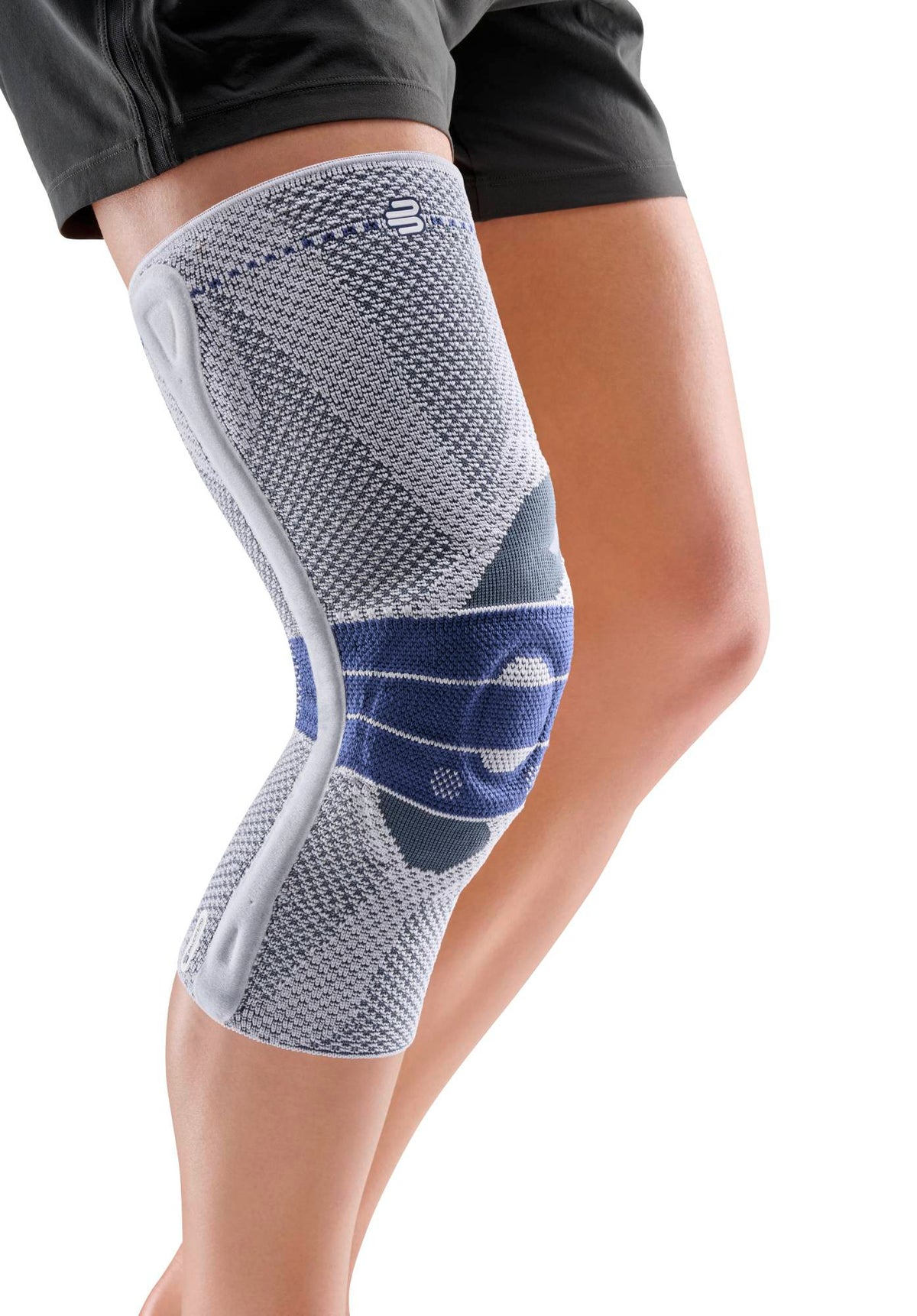
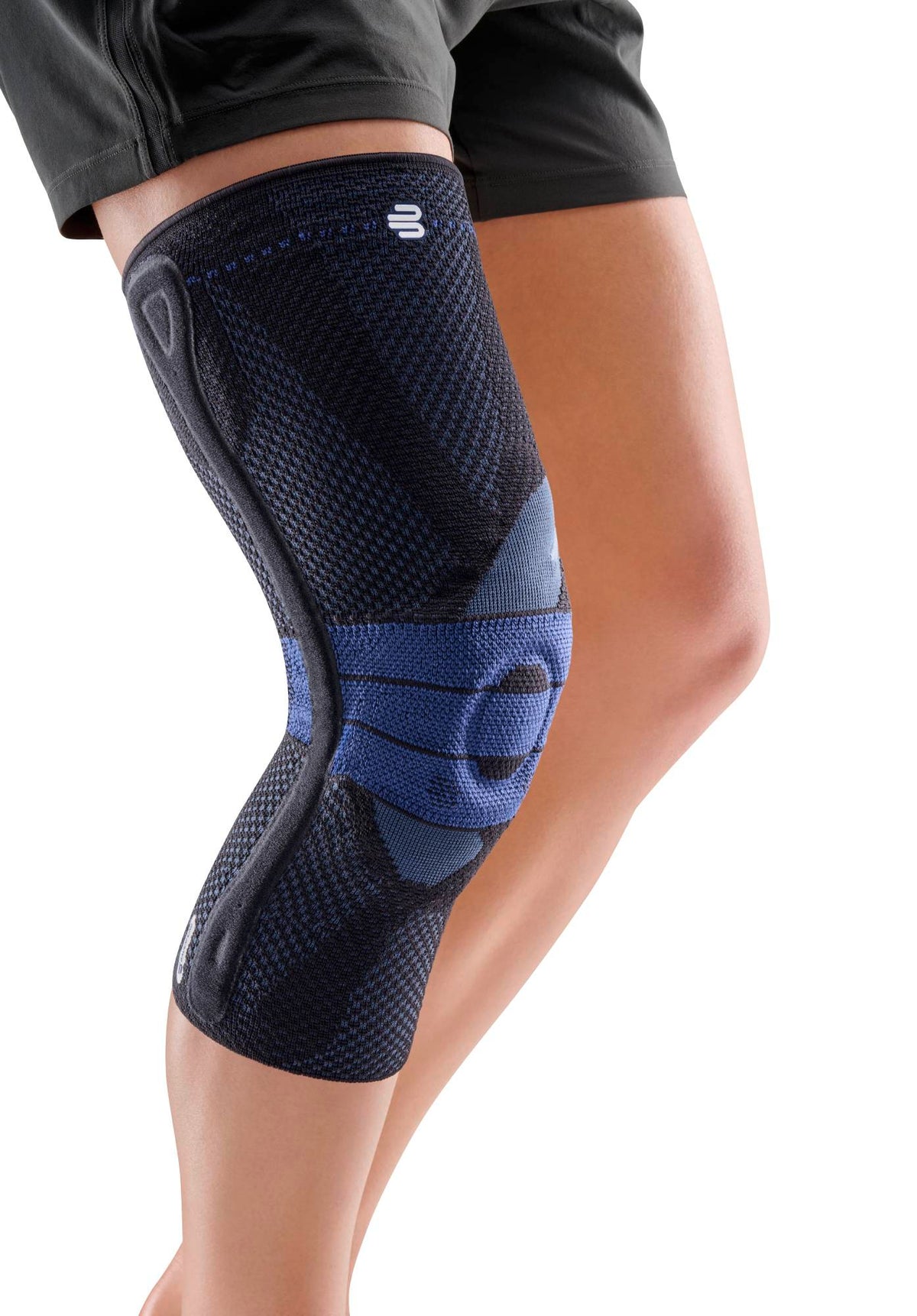
- Bauerfeind GenuTrain Knee Support: the knitted compression sleeve with the Omega+ pad, suited to skiers with knee osteoarthritis or a previous injury who want the joint to feel more secure. Worn directly against the skin under your ski trousers.
- Bauerfeind GenuTrain S Pro Knee Support: adjustable hinges and inelastic straps that can limit the knee's flexion and extension range during certain phases of treatment. For skiers returning after a ligament injury, and only with your clinician's guidance.
- Bauerfeind Sports Knee Support: the lightweight sports-line knit with a kneecap pad and a silicone grip band, for skiers with healthy knees who want compression and a secure fit through a long day.
Browse the full skiing and snowboarding supports range. For a closer look at the product options, read knee support for skiing, and for what to do when it aches afterwards, preventing knee pain after snowboarding.
Quick answers
How many weeks before skiing should I start training?
Six weeks is a realistic minimum for measurable gains in leg strength and control, with three sessions a week. If you have less time, do what you can: two weeks of wall sits, step-downs and single-leg balance is still better than arriving cold.
Do I need a knee support for skiing if my knees are healthy?
Probably not for joint sense. In the Tübingen study a GenuTrain support made no measurable difference to position sense in 120 healthy knees. Some skiers with healthy knees still like the compression and warmth of a lightweight sports support on long days, which is a comfort choice rather than a clinical one.
Which knee support is best for skiing after an ACL injury?
That depends on how stable the knee is and should be decided with your physiotherapist or surgeon. A knitted sleeve such as the GenuTrain works on awareness and confidence. A hinged support such as the GenuTrain S Pro adds side splints and can restrict range of movement during certain phases of treatment.
Can exercises prevent knee injuries when skiing?
Strength, balance and landing training are widely recommended by physiotherapists to prepare the knee for skiing, and they make the first days on snow far less of a shock. No study in this article measured injury rates, so we cannot put a number on prevention.
Should I wear the knee support under or over my base layer?
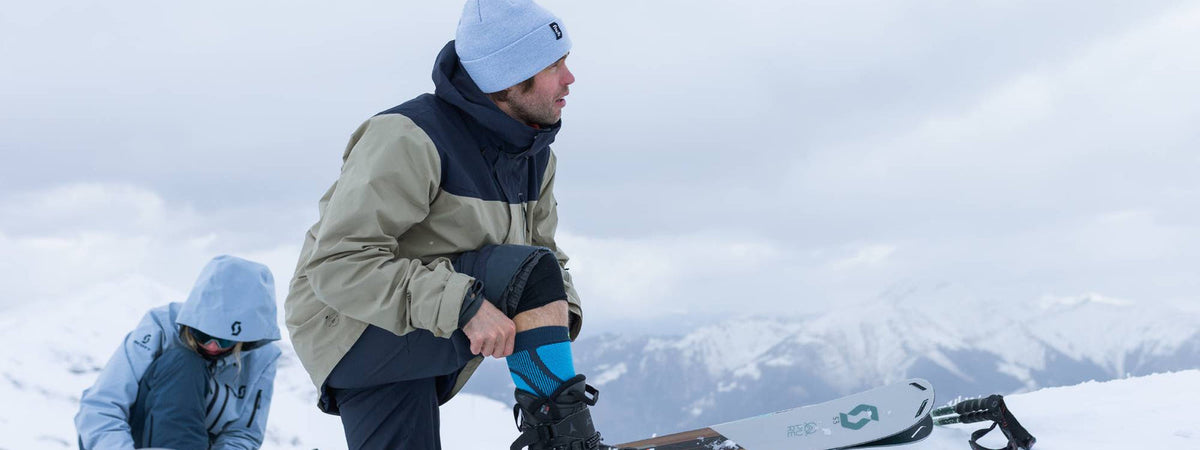
Compression supports are designed to be worn directly against the skin, with your ski trousers over the top. Make sure the lower edge sits clear of the boot cuff so it does not bunch, and take it off when you stop skiing for the day.
This article is for general information only and is not medical advice. If you have persistent pain, swelling, locking, giving way or an injury, speak to a GP or physiotherapist before using a support. Reviewed by the Joint Operations product team.
Sources
- Sell S, Zacher J, Lack S (1993). Proprioception decline in the osteoarthritic knee. Zeitschrift für Rheumatologie 52: 150-155.
- Schween R, Gehring D, Gollhofer A (2015). Immediate Effects of an Elastic Knee Sleeve on Frontal Plane Gait Biomechanics in Knee Osteoarthritis. PLoS ONE 10(1): e0115782.
- Sole G, et al. (2022). Knee kinematics and kinetics during a step-down hop with and without a knee sleeve following ACL reconstruction. BMC Musculoskeletal Disorders 23: 560.