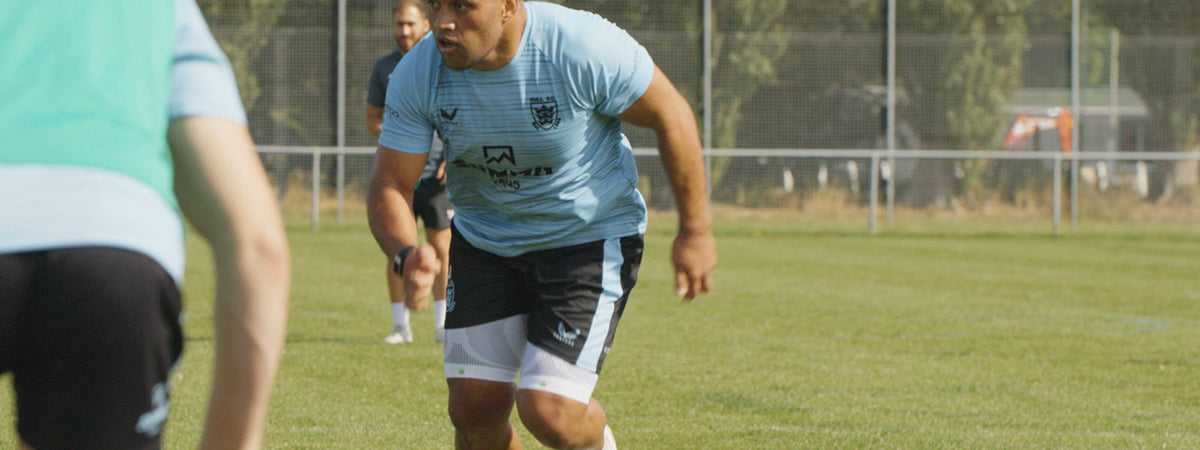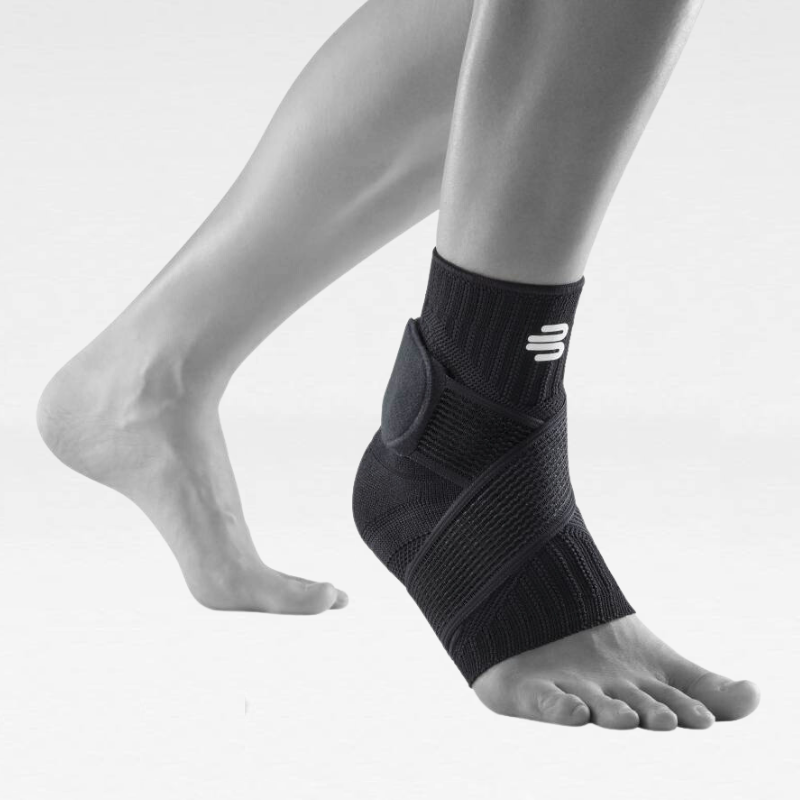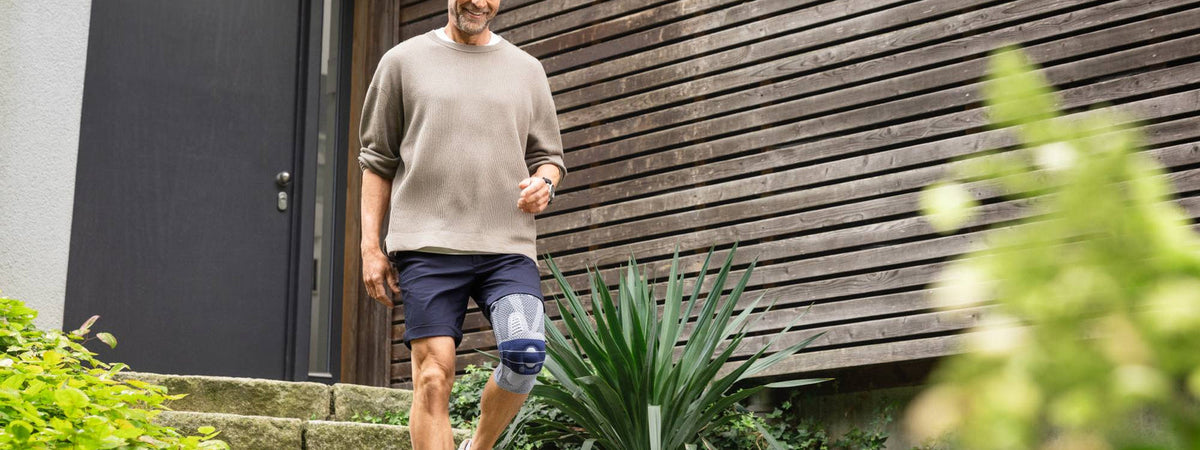
A knee support for osteoarthritis does not hold the joint still. In two clinical studies, people with knee osteoarthritis who walked in a Bauerfeind GenuTrain knee support showed a small reduction in inward loading on the knee, better awareness of where the knee was in space, and most said the knee felt more stable.
At a glance
- In a University of Freiburg gait study of 18 adults with knee osteoarthritis, the peak inward-loading moment on the knee was about 10% lower when walking in a GenuTrain sleeve.
- The same study found the inward (adduction) angle of the knee at foot contact was reduced by 1.9 degrees on average.
- Participants rated their knee as more stable with the sleeve, a median increase of 2.5 points on a 10-point scale.
- In a University of Tübingen study of 59 people with knee osteoarthritis, average age 70, joint position sense improved from 13.1 to 11.2 degrees of error with the support.
- The support made no measurable difference to joint position sense in 120 people with healthy knees.
Why this matters as the clocks go back
The clocks go back on Sunday 25 October, and for many people with knee osteoarthritis that is the point in the year when walking quietly drops off. Darker evenings, wet pavements and a knee that feels stiff after sitting all make the sofa more tempting than the park.
That is a problem, because walking is one of the most useful things you can do for an osteoarthritic knee. Physiotherapists and GPs recommend it precisely because it keeps the joint moving and the muscles around it working. So the question we hear most in autumn is a practical one: will a knee support make walking feel more comfortable and secure, and is there any evidence behind that?
This article looks at two studies that measured exactly that, using Bauerfeind GenuTrain knee supports, and explains what the numbers mean for your next walk.
What a knee support for osteoarthritis actually does
Osteoarthritis is the gradual wearing of the cartilage that cushions the ends of the bones in a joint. In the knee it most often affects the inner (medial) side, which is why many people with knee osteoarthritis feel their knee drifting inwards, or bowing, as they walk.
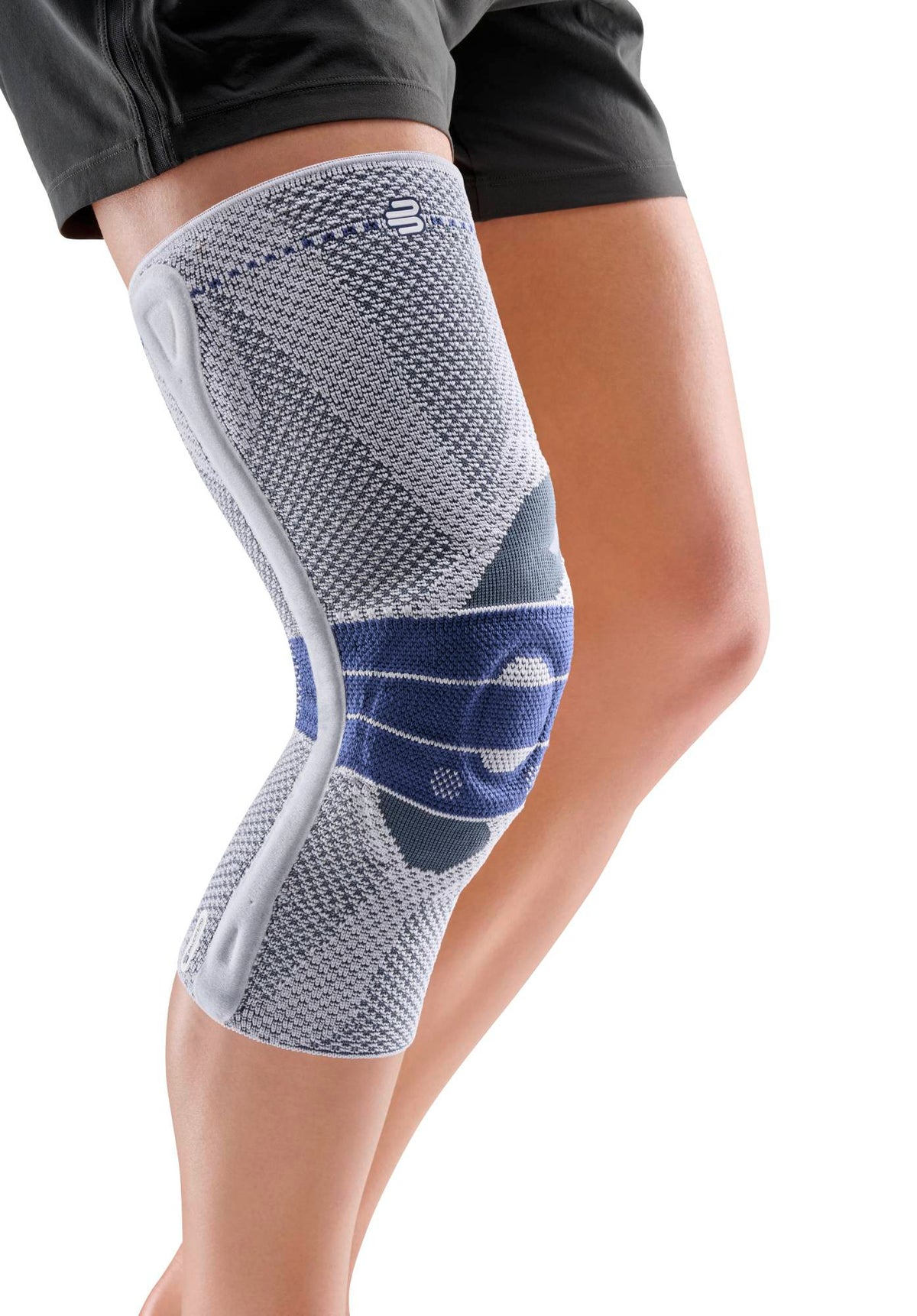
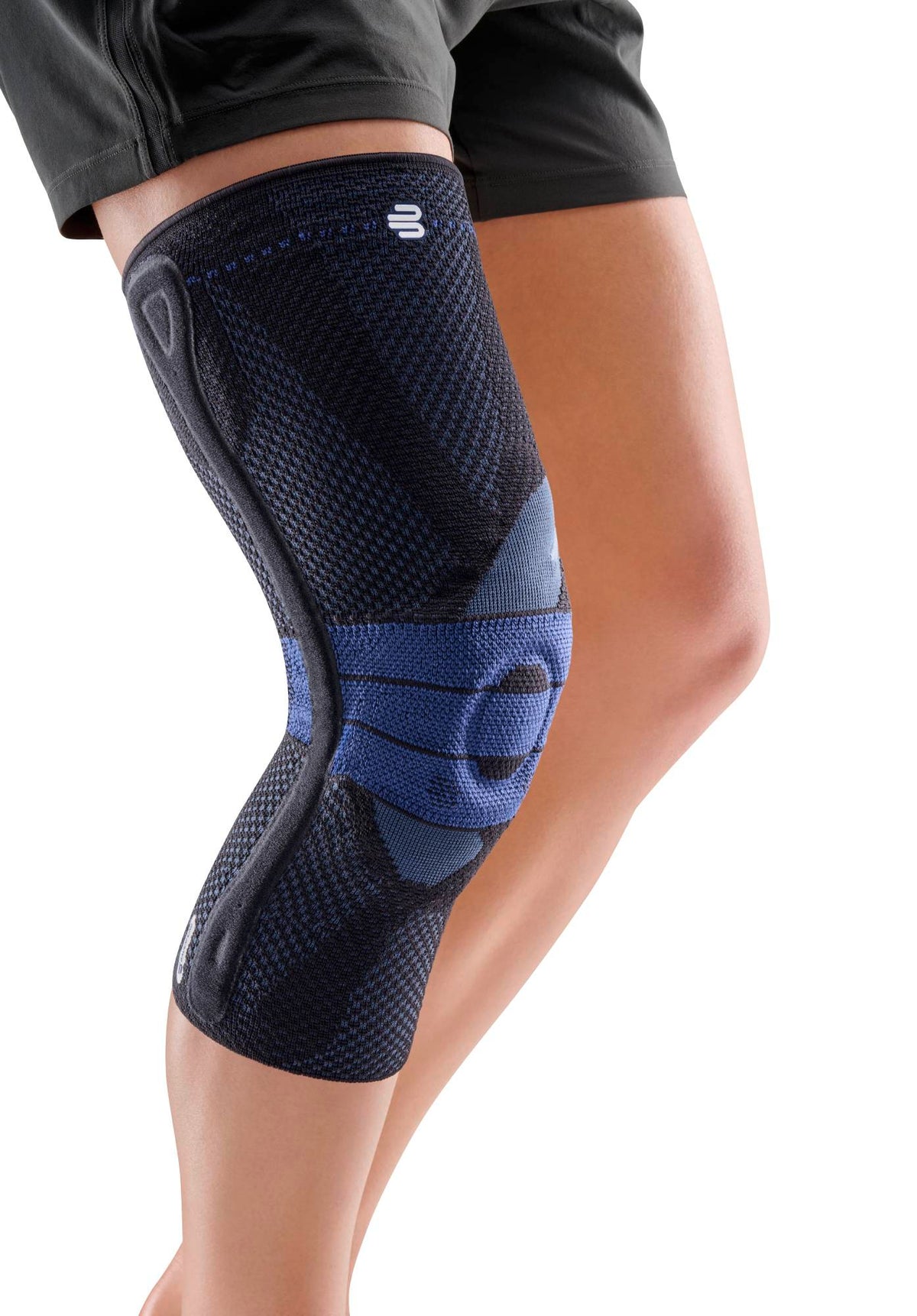
A compression knee support such as the GenuTrain is a knitted sleeve with a soft pad that sits around the kneecap. It is not a rigid brace and it does not lock the joint. Instead, researchers believe it works mainly through a sense called proprioception.
Proprioception: your knee's sense of position
Proprioception is the body's ability to sense where a joint is and how it is moving, without looking at it. It relies on receptors in the skin, muscles and the joint itself. When those signals are weaker, the brain has less to work with, and the knee can feel unreliable or unsteady.
Knee osteoarthritis is associated with poorer proprioception. The constant, gentle contact of a knitted support on the skin, and the movement of the pad over the kneecap as you walk, appear to give the nervous system more information about the joint. That is the leading explanation for why a soft sleeve can make a knee feel more secure even though it provides little mechanical bracing.
What the research says about GenuTrain and walking
Study one: walking biomechanics, University of Freiburg, 2015
Schween, Gehring and Gollhofer at the University of Freiburg's Department of Sport Science published a laboratory gait study in the journal PLoS ONE in 2015. Eighteen adults aged 25 to 65 with physician-diagnosed osteoarthritis, most pronounced on the inner side of the knee, walked across a force plate at their normal pace, ten times with a GenuTrain sleeve on the affected knee and ten times without. Three-dimensional motion capture measured how the knee moved and how it was loaded.
With the sleeve on:
- The inward (adduction) angle of the knee at the moment the foot landed was reduced by 1.9 degrees on average, and the peak inward angle during the step was reduced by 1.5 degrees.
- The first peak of the knee adduction moment, a standard measure of load on the inner compartment of the knee, was about 10% lower.
- The total inward-loading impulse over the stance phase was 12.9% lower, while the time the foot spent on the ground was unchanged.
- At the end of the session, participants rated their knee as feeling more stable with the sleeve, a median increase of 2.5 points on a 10-point scale. The change in pain was slight, a median of half a point.
Two honest caveats. These were immediate, same-day measurements, so the study does not tell us what happens over weeks or months of wear. And four of the 18 participants responded differently from the group average, which is a reminder that no support suits everyone. The study was part-funded by Bauerfeind, which the authors state had no role in the design, analysis or decision to publish.
The researchers concluded that the sleeve's low mechanical stiffness makes a bracing effect unlikely, and that improved proprioception is the more plausible explanation for the changes they measured.
Study two: joint position sense, University of Tübingen, 1993
Sell, Zacher and Lack at the Orthopaedic Hospital of the University of Tübingen tested joint position sense in 59 people with clinically and radiologically confirmed knee osteoarthritis, average age 69.8 years, and compared them with 40 healthy adults under 30 and 80 healthy adults over 50. Each person was asked to reproduce a set knee angle without looking, and the error in degrees was recorded, with and without a GenuTrain active knee support.
- People with knee osteoarthritis were considerably worse at sensing knee position than healthy people of a similar age: 13.1 degrees of error in the passive test against 8.3 degrees in the healthy over-50s.
- With the support on, the osteoarthritis group's error fell from 13.1 to 11.2 degrees in the passive test and from 14.2 to 12.5 degrees in the active test.
- The support made no measurable difference in the 120 people with healthy knees.
- Participants who had been doing regular physiotherapy for the previous three months had better joint position sense in the active test than those who had not.
The authors' interpretation is that the support compensates for a sensory deficit rather than physically stabilising the joint, which they describe as providing minimal, if any, mechanical stabilisation. The finding on physiotherapy is worth underlining: a support complements exercise, it does not replace it.
Five steps for walking with knee osteoarthritis this autumn
- Keep the habit, shorten the loop. A 20-minute walk in daylight is worth more than a 60-minute walk you keep postponing. Lunchtime walks suit the shorter days.
- Warm up before you head out. A few minutes of gentle marching on the spot and sit-to-stands from a chair get the muscles around the knee working before they take load on uneven ground.
- Choose grippy, cushioned footwear. Wet leaves and slick paving are the autumn hazards. A stable shoe reduces the small slips that make an unsteady knee feel worse.
- Put the support on before you start, not after it hurts. Both studies measured the support in use during activity. Wear it for the walk, then take it off to rest.
- Pair it with your exercises. The Tübingen study linked regular physiotherapy to better joint awareness. If you have been given strengthening exercises, keep doing them through the winter.
Which knee support is right for you?
Bauerfeind makes several GenuTrain supports and they are not interchangeable. The right one depends on where your osteoarthritis is and how your knee behaves.
- Bauerfeind GenuTrain Knee Support: the everyday compression support with the Omega+ pad around the kneecap. The closest product to the sleeves used in the walking study, and the usual starting point for general knee osteoarthritis and stiffness. Available in 13 sizes including Comfort sizes for a more conical leg shape.
- Bauerfeind GenuTrain A3 Knee Support: designed for osteoarthritis, irritated knee joints and complex knee pain, with a two-component pad that targets the muscles that stabilise the knee. Often chosen by active older adults.
- Bauerfeind GenuTrain OA Knee Support: for osteoarthritis that is clearly on one side of the knee. Its adjustable unloading system is designed to relieve the inner or outer compartment, and you can fine-tune the relief yourself with the Boa Fit System dial.
- Bauerfeind GenuTrain S Knee Support: adds side bars and straps for people whose osteoarthritis comes with slight instability and who want more passive support than a sleeve alone.
Browse the full Knee: Everyday Pain and Support range, or see our supports for hiking if longer walks are your goal. For more on the condition itself, read our guide to knee arthritis causes, symptoms and treatment.
Quick answers
Does a knee support help osteoarthritis?
A compression knee support can help a knee with osteoarthritis feel more stable and better controlled during activity. In a Freiburg gait study, participants walking in a GenuTrain sleeve showed about 10% lower peak inward loading on the knee and rated the joint as more stable. It is not a cure and it does not repair cartilage, but it can make staying active easier.
How does a knitted knee support work if it is not rigid?
Mainly through proprioception, the sense of joint position. Researchers in Tübingen found a GenuTrain support improved joint position sense in people with knee osteoarthritis but made no difference in healthy knees, which suggests it compensates for weaker sensory feedback rather than physically bracing the joint.
Should I wear a knee support all day?
Wear it when you are active, which is when the studies measured its effect, and take it off to rest and at night. Follow the wearing instructions supplied with the product. If you have been given a wearing plan by a clinician, follow that.
Will a knee support make my leg muscles weaker?
The studies discussed here did not measure muscle strength over time, so we cannot say either way. What the Tübingen study did find is that people doing regular physiotherapy had better joint awareness. Treat a support as a companion to strengthening exercise, not a substitute for it.
What is the difference between GenuTrain and GenuTrain OA?
GenuTrain is a compression sleeve with a pad around the kneecap, suited to general knee osteoarthritis. GenuTrain OA adds an adjustable unloading system designed to relieve one compartment of the knee, for people whose osteoarthritis is clearly on the inner or outer side. If you are unsure which side is affected, ask your GP or physiotherapist.
Can I walk and hike in a knee support?
Yes. Walking is exactly what the Freiburg study measured, and compression supports are designed to be worn during activity. For longer walks and descents, choose a support that fits well and does not slip, and build distance gradually through the autumn.
This article is for general information only and is not medical advice. If you have persistent pain, swelling, locking, giving way or an injury, speak to a GP or physiotherapist before using a support. Reviewed by the Joint Operations product team.
Sources
- Schween R, Gehring D, Gollhofer A (2015). Immediate Effects of an Elastic Knee Sleeve on Frontal Plane Gait Biomechanics in Knee Osteoarthritis. PLoS ONE 10(1): e0115782.
- Sell S, Zacher J, Lack S (1993). Proprioception decline in the osteoarthritic knee. Zeitschrift für Rheumatologie 52: 150-155.